
This Weekend's BOWLS Celebrates an Art Form with an Important History (For Both Humanity and The Art Center!)

Ceramics are an art form that have been around since the Neolithic era, quietly impacting our civilization’s development and acting as a vital record of ancient cultures. Humanity has been crafting things out of clay since at least 28,000 BCE, when the Venus of Dolní Věstonice (the oldest known ceramic piece in the world) was created.
Functional clay vessels do not appear to have been developed until much later than this ancient sculpture. Some of the oldest known pottery dates around 20,000 years ago and was found in China in Xianrendong Cave. These ceramic vessels predate the development of agriculture, and it is theorized that they were used for cooking food.
Having a versatile means to make vessels for both cooking and storage was a big deal for the development of humankind. Cooking vessels expanded the variety of foods people were able to cook over open flames, which allowed them to get more energy and nutrients from a wider range of food sources. Durable and waterproof storage was a major quality-of-life improvement, allowing more efficient means of transporting water than leaky animal skin containers and elongating the shelf life of food. With less time spent on everyday survival tasks and greater nutritional yield from cooked foods, humankind could apply more of its collective brainpower to other important societal developments.
Given that humanity has a deep and fundamental instinct for creating art, it is no surprise that ceramics have always been as much an art form as they have been a useful tool for survival. Bronze and Iron Age ceramic baby bottles have been discovered in the shape of little creatures, complete with feet and a spout formed to look like a tail. An entire archeological cultural group from the Late Neolithic through the early Bronze Age is named the “Corded Ware culture” after its pots decorated by wrapping cords around the wet clay before firing. And, of course, Greek pottery is famous for its decorative scenes depicting historical and mythological stories.

In the clay studio here at The Art Center, we are continuing the decorative and functional ceramics arts tradition, though we are greatly enjoying the benefits of thousands of years of development. We have different clay bodies from which to choose, we have a wide range of glazes to finish our work, and we have six electric kilns that give us a lot of control over firing (the HOA and the fire department won’t let us set fires to finish our pottery, so the ancient ways are denied to us here, unfortunately).
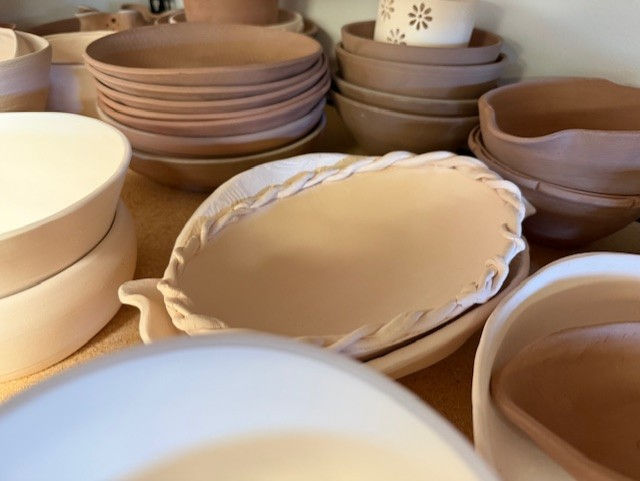
While our equipment and our clay look different from the materials of old, we still use many of the same methods that have been used by people for thousands of years. Our handbuilding side of the clay studio teaches the traditional techniques of pinch, slab, and coil. These were the first methods used to construct sculptures and functional pottery out of clay.

The pottery wheel wasn’t invented for many thousands of years after ceramics arts began. A likely precursor to the pottery wheel was a simple mat or large leaf used to allow the ceramicist to move their piece around as they worked it by hand. The precise origin of the pottery wheel is debatable, with the popular origin story attributing the invention to the Sumerians, but there is some evidence of potentially older wheels in Ukraine and China. Early wheels were turned by hand or foot, with improvements made over centuries until the addition of an axle and a flywheel gave potters the ability to control the spin with their feet and keep both hands available for forming the pot. Our wheels at The Art Center are electric powered, but they still use a foot pedal to control the spin, and the methods of drawing the clay into the desired shape remain the same as they have been for thousands of years.
There is something strangely satisfying about connecting with an art form that has been part of humanity’s living experience for millennia. The feel of the clay taking shape in your palms, turning into something beautiful, whimsical, or useful, is a grounding experience. Many of our clay students describe it as almost addictive, and, given the number of students who have been taking ceramics classes at The Art Center for more than ten years, there is some evidence for that.

The community in our clay studio has been one of the fastest growing parts of The Art Center. The clay studio was the impetus for moving from our original one room schoolhouse location to the current building. We were seeking to have space for kilns and bought this building in 2005. The tiles on our desk in the front lobby and behind the sink in Room 2 were made by students after we bought the building and fired in our new kilns. Since then, the clay studio has been a booming facet of The Art Center. Students have made lifelong friendships through their classes and continue to sign up session after session to get the chance to make their work in the company of the people they met years ago. One of our teachers, Cathi Brostrom, has been teaching in the clay studio for the past 19 years, and several of our students have gone on to have thriving careers as instructors (both at The Art Center and elsewhere) or independent potters (one of whom even sold a piece to Kathy Ireland!).

This Saturday, we celebrate the clay studio with our highly anticipated annual BOWLS event. The teachers and longtime students have been hard at work creating hundreds of handmade bowls, mugs, oil jars, and other specialty items to sell. Meanwhile, our community is stepping up to compete in our chili cook-off, offering free samples of different chilis to everyone who comes through. The clay studio will be lively with demonstrators showing their process and answering any questions you might have about creating ceramics from scratch. Over the years we’ve held BOWLS, we’ve been able to raise funds to help expand the program, buy new kilns, start a new glazing program, and keep the much-used equipment maintained. Our visitors love adding handmade one-of-a-kind pieces to their collections, finding unique gifts for their loved ones, and connecting with each other and our ceramicists. It’s always a big party atmosphere at BOWLS!
We hope to see you there this Saturday February 21 from 4:00-7:00 PM! Entry is free and light refreshments will be served.
And if you or your child are interested in connecting to this ancient art form yourself or for your child, our spring classes and summer camps are currently open for registration!


