
The Art Center's Printmaking Exhibition Celebrates a Long History of Art as Messaging
When we think of printing in the modern era, we’re more likely to envision fighting with a machine that refuses to work before a deadline due to “low toner” than we are to think about art. It’s easy these days to take for granted the ability to reproduce text and images, but the art of printmaking has been an incredibly powerful tool for communicating ideas, information, and emotion throughout history.
Printmaking started in ancient times with woodcuts, with the earliest known woodblock print dated somewhere between 206 B.C.E to 220 A.D. Woodcuts, along with linocuts (where the image is cut out of linoleum) fall into the category of relief printmaking. The raised parts of the wood or linoleum are what hold the ink and transfer onto the paper, much like a stamp.

Woodcuts were an early method of book printing. While it was still difficult to carve the letters into a block of wood, the ability to pull multiple copies off a single block made books more widely available to people who were not at the upper echelons of society. Putting more books into the hands of people helps ideas and information to spread quickly, leading to innovations not only in science and art, but in social structures and concepts.
Relief prints are typically very graphic and high contrast images. Fine detail is extremely difficult to create when carving out these materials, especially when dealing with the challenges of wood grain.

Intaglio printing, on the other hand, is a far more versatile series of printmaking techniques for creating complicated, detailed, and multi-tinted images. Intaglio, unlike relief, creates indentations in the surface that holds the ink and usually uses a press to transfer ink onto the prepared paper. It is a higher barrier to entry than relief printing, requiring special tools and often tedious image making methods, but the printing plates have a longer lifespan than wood or linoleum and the images can be far more complex.

One famous intaglio printmaker was Francisco Goya, whose etching series The Disasters of War are considered visual protest against the cruelty of the Dos de Mayo Uprising. The intricate detail possible with the etching technique makes the depictions of war starkly real to the viewer in a way that a more stylized technique couldn’t achieve.

Serigraphy, more commonly known as screen printing, is a form of stencil printing that really boomed in the 60’s. The versatility of serigraphy made it an increasingly popular form of printing. Screen printing can be done on many surfaces, including t-shirts, which makes it easier to distribute prints in accessible ways. The equipment for screen printing is often more mobile and accessible than heavy printing presses, and the colorful graphic design elements common to the printing form make it easy to catch the eye and communicate ideas to a broader public.
Atelier Populaire in late 60’s France was a printshop founded by a group of art students from École des Beaux-Arts and is famous for its screen printed minimalist protest posters. The students were protesting the policies of Charles De Gaulle and the brutal police response to sit-ins and demonstrations. After trade unions went on strike, the students used the lithography studios to create lithographs and screen prints to spread the word and build solidarity with the striking workers.

In London, the Poster Workshop performed much the same function. It operated out of a basement and made posters for groups fighting against unfair rent increases, protestors against the Vietnam War, and even the Brixton arm of the Black Panthers.

Over in the United States, the Black Panther Party was also using screen printing to illustrate posters and newspapers to communicate the ideals of the movement. Emory Douglas, a printmaker who studied at City College of San Francisco, became a valuable member of the Party. His expertise in the printmaking process helped them to launch a newspaper in April of 1967. Douglas created an iconic graphic design standard that bolstered the visibility of the Party’s message and called out the brutal reality of oppression.

Our 2026 Black History Month Exhibition, Black Joy as Power and Resistance: African American Printmakers, celebrates the continuing legacy of American printmaking as a tool of communication and social justice movements. It is a collection of works by local printmakers, as well as works on loan from the Experimental Printmaking Institute. These works are by incredible printmakers of historical note, including but not limited to:
David Driskell
David Driskell was a multimedia artist, a scholar, and a curator who was considered one of the world’s leading scholars of African-American Art. The High Museum’s annually awarded David C. Driskell Prize was established in 2005 to honor contributions to African-American art and art history, and the David C. Driskell Center at the University of Maryland, where he was department chair and a Distinguished University Professor of Art, was named for him and currently holds an archive of his work.
Faith Ringgold
Faith Ringgold was a Harlem artist and activist who wrote and illustrated over a dozen children’s books, participated in several organizations promoting feminism and fighting racism, protested the lack of inclusion of both women and people of color in art exhibitions, and mastered a huge range of art forms. Her work is included in several prominent permanent collections, including the Guggenheim Museum.
Sam Gilliam
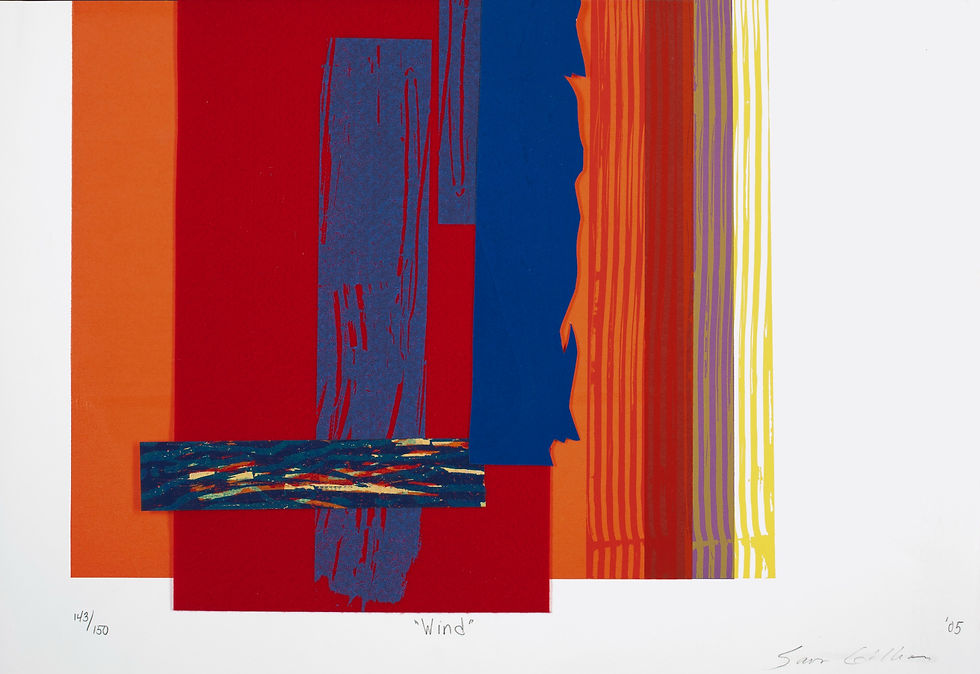
Sam Gilliam was a multimedia artist and arts educator, working in abstracts and often combining painting and sculpture. He is considered influential in the development of installation art, and he was one of the first Black artists to represent the United States at the Venice Biennale. He is the namesake of the annual $75,000 Sam Gilliam Award, given to an individual artist to support their practice.
Emma Amos
Emma Amos was an Atlanta-born postmodern printmaker and painter. She worked in printmaking studios in New York City, was involved in the Guerilla Girls feminist group, and she designed the memorial for Ralph David Abernathy, which you can see at the Ralph David Abernathy Memorial Park in Atlanta.
These are just a few of the incredible artists on display in our gallery. Join us this Saturday, March 7, from 6:00-7:30 pm to celebrate the closing reception for Black Joy as Power and Resistance: African American Printmakers and see these impactful works for yourself. The event is free to attend, open for all ages, and features delicious treats from The Art Center’s Guild!


